Sunday, May 24, 2015

ASP.NET MVC - Application Folders


MVC Folders

A typical ASP.NET MVC web application has the following folder content:


Application information
Properties
References
Application folders
App_Data Folder
Content Folder
Controllers Folder
Models Folder
Scripts Folder
Views Folder
Configuration files
Global.asax
packages.config
Web.config

The folder names are equal in all MVC applications. The MVC framework is based on default naming. Controllers are in the Controllers folder, Views are in the Views folder, and Models are in the Models folder. You don't have to use the folder names in your application code.Standard naming reduces the amount of code, and makes it easier for developers to understand MVC projects.
Below is a brief summary of the content of each folder:

The App_Data Folder

The App_Data folder is for storing application data. Eg: SQL Database

The Content Folder

The Content folder is used for static files like style sheets (css files), icons and images.Visual Web Developer automatically adds a themes folder to the Content folder. The themes folder is filled with jQuery styles and pictures. You can delete the themes folder.Visual Web Developer also adds a standard style sheet file to the project: the file Site.css in the content folder. The style sheet file is the file to edit when you want to change the style of the application.


The Controllers Folder

The Controllers folder contains the controller classes responsible for handling user input and responses.MVC requires the name of all controller files to end with "Controller". Visual Web Developer has created a Home controller (for the Home and the About page) and an Account controller (for Login pages):


The Models Folder

The Models folder contains the classes that represent the application models. Models hold and manipulate application data.


The Views Folder

The Views folder stores the HTML files related to the display of the application (the user interfaces). The Views folder contains one folder for each controller. Visual Web Developer has created an Account folder, a Home folder, and a Shared folder (inside the Views folder). The Account folder contains pages for registering and logging in to user accounts. The Home folder is used for storing application pages like the home page and the about page. The Shared folder is used to store views shared between controllers (master pages and layout pages).
 

The Scripts Folder

The Scripts folder stores the JavaScript files of the application.By default Visual Web Developer fills this folder with standard MVC, Ajax, and jQuery files:

 
The files named "modernizr" are JavaScript files used for supporting HTML5 and CSS3 features in the application.


ASP.NET MVC - Internet Application

In the New Project dialog box:
  • Open the Visual C# templates
  • Select the template ASP.NET MVC 4 Web Application
  • Set the project name to MvcDemo
  • Set the disk location to something like D:\MVC\MvcDemo
  • Click OK
When the New Project Dialog Box opens:


  • Select the Internet Application template
  • Select the Razor Engine
  • Select HTML5 Markup
  • Click OK
Visual Studio will create a project much like this:


The MVC Programming Model


MVC is one of three ASP.NET programming models.
MVC is a framework for building web applications using a MVC (Model View Controller) design:
  • The Model represents the application core (for instance a list of database records).
  • The View displays the data (the database records).
  • The Controller handles the input (to the database records).
The MVC model also provides full control over HTML, CSS, and JavaScript.


The MVC model defines web
applications with 3 logic layers:

The business layer (Model logic)
The display layer (View logic)
The input control (Controller logic)
The Model is the part of the application that handles the logic for the application data.
Often model objects retrieve data (and store data) from a database.
The View is the parts of the application that handles the display of the data.
Most often the views are created from the model data.
The Controller is the part of the application that handles user interaction.
Typically controllers read data from a view, control user input, and send input data to the model.
The MVC separation helps you manage complex applications, because you can focus on one aspect a time. For example, you can focus on the view without depending on the business logic. It also makes it easier to test an application.
The MVC separation also simplifies group development. Different developers can work on the view, the controller logic, and the business logic in parallel.

Web Forms vs MVC

The MVC programming model is a lighter alternative to traditional ASP.NET (Web Forms). It is a lightweight, highly testable framework, integrated with all existing ASP.NET features, such as Master Pages, Security, and Authentication.

Using Authorization with Swagger in ASP.NET Core

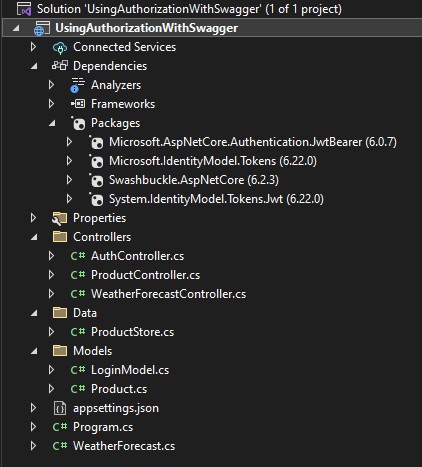
 Create Solution like below LoginModel.cs using System.ComponentModel.DataAnnotations; namespace UsingAuthorizationWithSwagger.Models {     ...