Saturday, May 21, 2016

Best Accounting Software for Really Small Businesses: Eazy Accounts

Eazy Accounts offers all the basic features like invoicing, customer order, bill payments, expense reports, financial reports and reconciliations that micro businesses need, as well as advanced tools that grow with your business. Furthermore, compared with other accounting software for really small businesses, Eazy Accounts has the best price for all of its capabilities.


  •  Masters
1.       Branch
2.       Category Type                                                                          
3.       Category     
4.       Cash Accounts                                          
5.       Bank
6.       First Account Balance            
7.       Store                            
8.       First Stock Input
9.       Country                                                                       
10.   State                                            
11.   District
12.   Financial Year                            
  • Employee
1.       Designation
2.       Department
3.       Qualification
4.       User Group
5.       Employee
6.       Users Details
7.       Privilege
8.       Monthly Salary
  • Purchase
1.       Purchase Invoice (Barcode scanner integration)
2.       Purchase Return Invoice
3.       Payment Voucher
4.       Supplier
5.       Product (Barcode scanner integration)
6.       Stock Transfer
  • Sales
1.       Sale Invoice(Barcode scanner integration)
2.       Sale Return Invoice
3.       Receipt Voucher
4.       Customer
  • Wholesale
1.       Add Output Item
2.       Edit Output Item
3.       Sales Invoice For Output Product     
  • Reports
1.       Daily Report
2.       Monthly Report
3.       Yearly Report
4.       Cash Credit Purchase
5.       Suppliers Account
6.       Cash Credit Sale
7.       Customers Account
8.       Cash/Bank Account
9.       Motion Inquiry
10.   Store Product Quantity
11.   Display Product Balance
12.   Product Low Quantity
13.   Product Motions Inquiry
14.   Profit Sale
15.   Motion Sales Total

Saturday, March 12, 2016

SELECT Column Value from Table to SET Variable

DECLARE @P_RET_VAL INT;

SET @P_RET_VAL = ( SELECT [PD_Id]
FROM [Products]  
WHERE [PD_No] = @PD_No
 )

Sunday, May 24, 2015

ASP.NET MVC - Views


The Views folder stores the files (HTML files) related to the display of the application (the user interfaces). These files may have the extensions html, asp, aspx, cshtml, and vbhtml, depending on the language content.The Views folder contains one folder for each controller. Visual Web Developer has created an Account folder, a Home folder, and a Shared folder (inside the Views folder).The Account folder contains pages for registering and logging in to user accounts.The Home folder is used for storing application pages like the home page and the about page.The Shared folder is used to store views shared between controllers (master pages and layout pages).


ASP.NET File Types

The following HTML file types can be found in the Views Folder:
File Type
Extention
Plain HTML
.htm or .html
Classic ASP
.asp
Classic ASP.NET
.aspx
ASP.NET Razor C#
.cshtml
ASP.NET Razor VB
.vbhtml

The Index File

The file Index.cshtml represents the Home page of the application. It is the application's default file (index file).
Put the following content in the file:

@{
    ViewBag.Title = "Home Page";
}
@section featured {
    <section class="featured">
        <div class="content-wrapper">
            <hgroup class="title">
                <h1>@ViewBag.Title.</h1>
                <h2>@ViewBag.Message</h2>
            </hgroup>
            <p>
                To learn more about ASP.NET MVC visit
                <a href="http://asp.net/mvc" title="ASP.NET MVC Website">http://asp.net/mvc</a>.
                The page features <mark>videos, tutorials, and samples</mark> to help you get the most from ASP.NET MVC.
                If you have any questions about ASP.NET MVC visit
                <a href="http://forums.asp.net/1146.aspx/1?MVC" title="ASP.NET MVC Forum">our forums</a>.
            </p>
        </div>
    </section>
}
<h3>We suggest the following:</h3>
<ol class="round">
    <li class="one">
        <h5>Getting Started</h5>
        ASP.NET MVC gives you a powerful, patterns-based way to build dynamic websites that
        enables a clean separation of concerns and that gives you full control over markup
        for enjoyable, agile development. ASP.NET MVC includes many features that enable
        fast, TDD-friendly development for creating sophisticated applications that use
        the latest web standards.
        <a href="http://go.microsoft.com/fwlink/?LinkId=245151">Learn more…</a>
    </li>

    <li class="two">
        <h5>Add NuGet packages and jump-start your coding</h5>
        NuGet makes it easy to install and update free libraries and tools.
        <a href="http://go.microsoft.com/fwlink/?LinkId=245153">Learn more…</a>
    </li>

    <li class="three">
        <h5>Find Web Hosting</h5>
        You can easily find a web hosting company that offers the right mix of features
        and price for your applications.
        <a href="http://go.microsoft.com/fwlink/?LinkId=245157">Learn more…</a>
    </li>
</ol>


The About File

The file About.cshtml represent the About page of the application.
Put the following content in the file:
 
@{
    ViewBag.Title = "About";
}

<hgroup class="title">
    <h1>@ViewBag.Title.</h1>
    <h2>@ViewBag.Message</h2>
</hgroup>

<article>
    <p>
        Use this area to provide additional information.
    </p>

    <p>
        Use this area to provide additional information.
    </p>

    <p>
        Use this area to provide additional information.
    </p>
</article>

<aside>
    <h3>Aside Title</h3>
    <p>
        Use this area to provide additional information.
    </p>
    <ul>
        <li>@Html.ActionLink("Home", "Index", "Home")</li>
        <li>@Html.ActionLink("About", "About", "Home")</li>
        <li>@Html.ActionLink("Contact", "Contact", "Home")</li>
    </ul>
</aside>


Run the Application

Select Debug, Start Debugging (or F5) from the Visual Web Developer menu.
Your application will look like this:


ASP.NET MVC - Controllers


The Controllers Folder

The Controllers Folder contains the controller classes responsible for handling user input and responses.MVC requires the name of all controllers to end with "Controller".In our example, Visual Web Developer has created the following files: HomeController.cs (for the Home and About pages) and AccountController.cs (For the Log On pages):


Web servers will normally map incoming URL requests directly to disk files on the server. For example: a URL request like "http://www.w3schools.com/default.asp" will map directly to the file "default.asp" at the root directory of the server.The MVC framework maps differently. MVC maps URLs to methods. These methods are in classes called "Controllers". Controllers are responsible for processing incoming requests, handling input, saving data, and sending a response to send back to the client.

The Home controller

The controller file in our application HomeController.cs, defines the two controls Index and About.
Swap the content of the HomeController.cs file with this:

using System;
using System.Collections.Generic;
using System.Linq;
using System.Web;
using System.Web.Mvc;

namespace MvcDemo.Controllers
{
    public class HomeController : Controller
    {
        public ActionResult Index()
        {
            ViewBag.Message = "Modify this template to jump-start your ASP.NET MVC application.";

            return View();
        }

        public ActionResult About()
        {
            ViewBag.Message = "Your app description page.";

            return View();
        }

        public ActionResult Contact()
        {
            ViewBag.Message = "Your contact page.";

            return View();
        }
    }
}


The Controller Views

The files Index.cshtml and About.cshtml in the Views folder defines the ActionResult views Index() and About() in the controller.
 

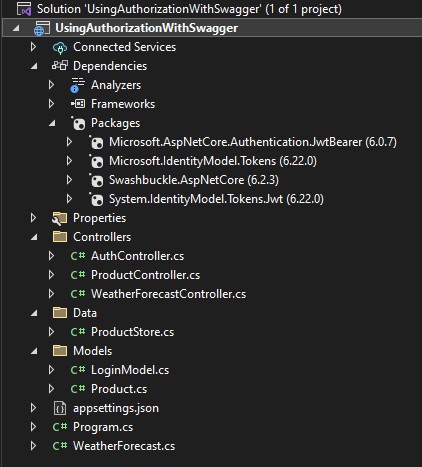
Using Authorization with Swagger in ASP.NET Core

 Create Solution like below LoginModel.cs using System.ComponentModel.DataAnnotations; namespace UsingAuthorizationWithSwagger.Models {     ...