Friday, March 14, 2008

Some HTML Tutorials

Flash Embedded in HTML

After creating a Flash movie you choose File > Save As from the top menu to save your movie. Save the file as "Somefilename.fla".

To embed the Flash movie you just made into an HTML page, you should go back to your Flash program and do the following steps:

Step 1
Choose File > Open. Open a Flash movie you have created.

Step 2
Choose File > Export Movie.

Step 3
Name the file "somefilename.swf". Choose the location where the file is to be stored (in your Web folder). Click OK.

Step 4
Open the HTML page where you want to insert your Flash movie. Insert this code:


Video and Image loading like Google Video in asp.net with c#

For Video loading firstly create database for storing the path of video and apply the html code shown below:


In code Page:


SqlConnection scn = new SqlConnection("Data Source=.;Initial Catalog=test;Integrated Security=True");
protected void Page_Load(object sender, EventArgs e)
{
scn.Open();
SqlDataAdapter da = new SqlDataAdapter("select * from video", scn);
DataSet ds = new DataSet();
da.Fill(ds);
DataList1.DataSource = ds;
DataList1.DataBind();
scn.Close();
}
Output:

Sunday, March 9, 2008

management studio creation in windows application

using System;
using System.Collections.Generic;
using System.ComponentModel;
using System.Data;
using System.Drawing;
using System.Linq;
using System.Text;
using System.Windows.Forms;
using System.Data.SqlClient;


namespace WindowsFormsApplication1
{
public partial class Form1 : Form
{
public Form1()
{
InitializeComponent();
}
SqlConnection con = new SqlConnection(@"Data Source=.\sqlexpress;Initial Catalog=Registration;Integrated Security=True");
SqlCommand cmd;
SqlDataReader dr;
DataTable dt = new DataTable();
private void btnexecute_Click(object sender, EventArgs e)
{


con.Open();
cmd = new SqlCommand(richTextBox1.Text, con);
dr = cmd.ExecuteReader();
dt.Load(dr);
dataGrid1.DataSource = dt;
cmd = new SqlCommand("sp_helpdb", con);
dr = cmd.ExecuteReader();
while (dr.Read())
{
treeView1.Nodes.Add(dr["name"].ToString());
}
dr.Close();
cmd = new SqlCommand("sp_helpdb", con);
dr = cmd.ExecuteReader();
while (dr.Read())
{
cboDb.Items.Add(dr["name"].ToString());
}
dr.Close();

}

private void newToolStripMenuItem_Click(object sender, EventArgs e)
{

}

private void openToolStripMenuItem_Click(object sender, EventArgs e)
{
openFileDialog1.Filter="Text File(*.txt)|*.txt";
string filename;
if(openFileDialog1.ShowDialog()==DialogResult.OK);
{
filename=openFileDialog1.FileName;
richTextBox1.LoadFile(openFileDialog1.FileName);

}

}

private void saveToolStripMenuItem_Click(object sender, EventArgs e)
{
saveFileDialog1.Filter = "Text File(*.txt)|*.txt";
saveFileDialog1.DefaultExt = "*.txt";
if (saveFileDialog1.ShowDialog() == DialogResult.OK)
{
richTextBox1.SaveFile(saveFileDialog1.FileName);
richTextBox1.Clear();
}
}

private void richTextBox1_TextChanged(object sender, EventArgs e)
{

}

private void cboDb_SelectedIndexChanged(object sender, EventArgs e)
{
cmd = new SqlCommand("use"+cboDb.Text,con);
dr = cmd.ExecuteReader();
dr.Close();

}
}
}

Creating Management Studio using asp.net

add this value and key in web.config


some sql statements:
sp_helpdb
SELECT * FROM sysobjects and sp_help


Html Coding for this:


using System.Data.SqlClient;
public partial class Default2 : System.Web.UI.Page
{

SqlCommand cmd;
SqlDataAdapter da;
DataSet ds=new DataSet();
SqlConnection cnn;
SqlDataReader dr;
String strDB;
protected void Page_Load(object sender, EventArgs e)
{
cnn = new SqlConnection(ConfigurationManager.AppSettings.Get("Cnn"));
cnn.Open();
da = new SqlDataAdapter("sp_helpdb", cnn);
da.Fill(ds, "Cat");
if (!IsPostBack)
{
ddlDb.DataSource = ds.Tables["Cat"];
ddlDb.DataTextField = "name";
DataBind();
}

}
protected void Wizard1_FinishButtonClick(object sender, WizardNavigationEventArgs e)
{

}

protected void ddlDb_SelectedIndexChanged(object sender, EventArgs e)
{
strDB = ddlDb.SelectedItem.ToString();
cnn = new SqlConnection("Data Source=.\\sqlexpress;Initial Catalog='"+strDB+"';Integrated Security=True");
da = new SqlDataAdapter("SELECT * FROM sysobjects WHERE xtype = 'u'", cnn);
da.Fill(ds, "student");
ddlTable.DataSource = ds.Tables["student"];
ddlTable.DataTextField = "name";
DataBind();


}


protected void ddlTable_SelectedIndexChanged(object sender, EventArgs e)
{

strDB = ddlDb.SelectedItem.ToString();
cnn = new SqlConnection("Data Source=.\\sqlexpress;Initial Catalog='" + strDB + "';Integrated Security=True");
cnn.Open();
cmd = new SqlCommand("sp_help " + ddlTable.SelectedItem.ToString(), cnn);
dr = cmd.ExecuteReader();
dr.NextResult();
while (dr.Read())
lstFields.Items.Add(dr["column_name"].ToString());

}
protected void btnExecute_Click(object sender, EventArgs e)
{
strDB = ddlDb.SelectedItem.ToString();
cnn = new SqlConnection("Data Source=.\\sqlexpress;Initial Catalog='" + strDB + "';Integrated Security=True");
cnn.Open();
{
SqlCommand smd = new SqlCommand(TextBox1.Text, cnn);
dr = smd.ExecuteReader();
{
DataTable dt = new DataTable();
dt.Load(dr);
DataGrid1.DataSource = dt;
DataGrid1.DataBind();
}
}


}
}

Friday, February 29, 2008

SerialPort (RS-232 Serial COM Port) in C# .NET for MIFARE

This article is about communicating through the PC's Serial COM RS-232 port using Microsoft .NET 2.0 or later by using the System.IO.Ports.SerialPort class.

using System.IO.Ports;
using System.Threading;
using System.Windows.Forms;

SerialPort port = new SerialPort("COM2", 9600, Parity.None, 8, StopBits.One);


try
{
port.Open();
port.Write("x");


Thread.Sleep(500);


string x = port.ReadExisting().ToString();
port.Write("c");
Thread.Sleep(500);
string c = port.ReadExisting().ToString();
port.Write(" ");
Thread.Sleep(500);
string p = port.ReadExisting().ToString();
port.Write("s");
Thread.Sleep(500);
string s = port.ReadExisting().ToString();
port.Write("l" + "01" + "FF" + "\r\n");

Thread.Sleep(500);
string l = port.ReadExisting().ToString();
port.Write("r" + "04");

Thread.Sleep(500);
string r = port.ReadExisting().ToString();

port.Write("r" + "04");
Thread.Sleep(500);
string t = port.ReadExisting().ToString();
Thread.Sleep(500);
port.Write("rv" + "04");

Thread.Sleep(500);

string v = port.ReadExisting().ToString();

//string u = v.Substring(0, v.IndexOf("\r\n"));
//int k = Convert.ToInt32(u, 16);
//// k = Int32.Parse(u, NumberStyles.HexNumber);

//TextBox1.Text = k.ToString();


int num = Convert.ToInt32(txtamt.Text);

string st = num.ToString("X");
int bt = st.Length;
for (int i = 0; i < 8 - bt; i++)
{
st = "0" + st;
}
port.Write("+" + "04" + st);
Thread.Sleep(500);

string b = port.ReadExisting().ToString();
string u = b.Substring(0, b.IndexOf("\r\n"));

int d = Convert.ToInt32(u, 16);

string j = d.ToString();
MessageBox.Show("Your Balance Amount is " + j);
}
catch (Exception ex)
{
throw ex;
}
port.Close();

Thursday, February 28, 2008

http://www.asp.net/


Microsoft ASP.NET is a free technology that allows programmers to create dynamic web applications. ASP.NET can be used to create anything from small, personal websites through to large, enterprise-class web applications. All you need to get started with ASP.NET is the free .NET Framework and the free Visual Web Developer.

Tuesday, February 26, 2008

Windows Workflow Foundation

Workflow means performing any task in order. Today, each application is based on workflow approach
and involves some processes to be executed. While creating an application, developers are still following
the traditional approach that leads to create steps in the process implicit in the code. This traditional
approach works fine, but requires a deep programming logic making the process difficult to change and execute.

Workflow engine is not a new technology; it came into existence in early 2000. In the market, several
workflow engines are available for Windows and other platforms. Today, all applications are based on
workflow approach. So, defining different engines for different applications is a cumbersome task. To
avoid this, Microsoft has decided to define a single common workflow engine for all the windows-based
applications. This is what the Windows Workflow Foundation (WF) performs. WF provides a common
workflow technology for all the windows-based applications, such as Microsoft Office 2007 and
Windows Share Point Services.

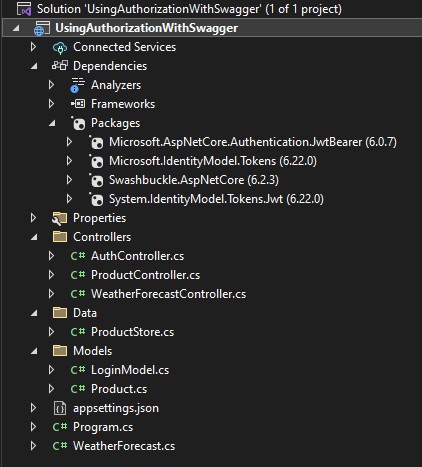
Using Authorization with Swagger in ASP.NET Core

 Create Solution like below LoginModel.cs using System.ComponentModel.DataAnnotations; namespace UsingAuthorizationWithSwagger.Models {     ...