Monday, February 25, 2008

Scott Guthrie


Scott Guthrie is a vice president in the Microsoft Developer Division. He runs the development teams that build ASP.NET, Common Language Runtime (CLR), Windows Presentation Foundation (WPF), Silverlight, Windows Forms, Internet Information Services 7.0, Commerce Server, .NET Compact Framework, Visual Web Developer and Visual Studio Tools for WPF. He is best known for his work on ASP.NET, which he and colleague Mark Anders developed while at Microsoft.[1]

SqlServer Database Connection in asp.net with C#

Microsoft SQL Server is a relational database management system (RDBMS) produced by Microsoft. Its primary query language is Transact-SQL, an implementation of the ANSI/ISO standard Structured Query Language (SQL) used by both Microsoft and Sybase.


Add SQL Connection in asp.net with c#:


How to get Connection String for SQLConnection :


Source Code :


using System;
using System.Data;
using System.Configuration;
using System.Collections;
using System.Web;
using System.Web.Security;
using System.Web.UI;
using System.Web.UI.WebControls;
using System.Web.UI.WebControls.WebParts;
using System.Web.UI.HtmlControls;
using System.Data.SqlClient;

public partial class data : System.Web.UI.Page
{
SqlConnection scn = new SqlConnection("Data Source=.;Initial Catalog=master;Integrated Security=True");

protected void Page_Load(object sender, EventArgs e)
{

}
}

Serial Communication with MSComm Control in windows application

Add Reference for Serial Communication:


Add MSComm Control For Serial Communication:


Serial Communication Form Design:


Source Code For Serial Communication:

using System;
using System.Collections.Generic;
using System.ComponentModel;
using System.Data;
using System.Drawing;
using System.Text;
using System.Windows.Forms;
using System.Globalization;
using System.IO;
using System.Diagnostics;
using System.Threading;

namespace mifaretest
{
public partial class Form2 : Form
{
public Form2()
{
InitializeComponent();
}
private static int num;
private static string st;

private void button1_Click(object sender, EventArgs e)
{
num = Convert.ToInt32(txtamt.Text);

st = num.ToString("X");
int bt = st.Length;
for (int i = 0; i < 8 - bt; i++)
{
st = "0" + st;
}
axMSComm1.Output = "+" + "04" + st;
Thread.Sleep(500);
if (axMSComm1.InBufferCount > 0)
{
string b = axMSComm1.Input.ToString();
string u = b.Substring(0, b.IndexOf("\r\n"));

int c = Convert.ToInt32(u, 16);

txtbal.Text = c.ToString();
}

}


private void Form2_Load(object sender, EventArgs e)
{
if (axMSComm1.PortOpen == false)
{
axMSComm1.PortOpen = true;
}


}

private void btnwithdrawal_Click(object sender, EventArgs e)
{
num = Convert.ToInt32(txtamt.Text);

st = num.ToString("X");
int bt = st.Length;
for ( int i = 0; i < 8 - bt; i++)
{
st = "0" + st;
}
axMSComm1.Output = "-" +"04" + st;
Thread.Sleep(500);
if (axMSComm1.InBufferCount > 0)
{
string b = axMSComm1.Input.ToString();
string u = b.Substring(0, b.IndexOf("\r\n"));

int c = Convert.ToInt32(u, 16);

txtbal.Text = c.ToString();
}

}


private static int i=0;
private static string x;
private static string c;
private static string p;
private static string s;
private static string l;
private static string r;
private static string t;
private static string v;
private static string u;
private static int k;
private void button2_Click(object sender, EventArgs e)
{
axMSComm1.Output = "x";
int o = axMSComm1.InBufferCount;

Thread.Sleep(500);
if (axMSComm1.InBufferCount > 0)
{
x = axMSComm1.Input.ToString();
}

axMSComm1.Output = "c";
Thread.Sleep(500);
if (axMSComm1.InBufferCount > 0)
{
c = axMSComm1.Input.ToString();
}
axMSComm1.Output = " ";
Thread.Sleep(500);
if (axMSComm1.InBufferCount > 0)
{
p = axMSComm1.Input.ToString();
}
axMSComm1.Output = "s";
Thread.Sleep(500);
if (axMSComm1.InBufferCount > 0)
{
s = axMSComm1.Input.ToString();
}
axMSComm1.Output = "l" + "01" + "FF" + "\r\n";
Thread.Sleep(500);
if (axMSComm1.InBufferCount > 0)
{
l = axMSComm1.Input.ToString();
}
axMSComm1.Output = "r" + "04";
Thread.Sleep(500);
if (axMSComm1.InBufferCount > 0)
{
r = axMSComm1.Input.ToString();
}
axMSComm1.Output = "r" + "04";
Thread.Sleep(500);
if (axMSComm1.InBufferCount > 0)
{
t = axMSComm1.Input.ToString();
}
Thread.Sleep(500);

axMSComm1.Output = "rv" + "04";
Thread.Sleep(500);
// string m = x + c + p + s + l + r + t;
if (axMSComm1.InBufferCount > 0)
{
v = axMSComm1.Input.ToString();

u = v.Substring(0, v.IndexOf("\r\n"));
k = Convert.ToInt32(u, 16);
k = Int32.Parse(u, NumberStyles.HexNumber);

txtbal.Text = k.ToString();

}

}


}
}

Architecure of .NET FRAMEWORK

CLI
Assemblies
Metadata
Class library
Security
Memory management

.NET FRAMEWORK

The Microsoft .NET Framework is a software component that is a part of Microsoft Windows operating systems. It has a large library of pre-coded solutions to common program requirements, and manages the execution of programs written specifically for the framework. The .NET Framework is a key Microsoft offering, and is intended to be used by most new applications created for the Windows platform.

The pre-coded solutions that form the framework's Base Class Library cover a large range of programming needs in areas including: user interface, data access, database connectivity, cryptography, web application development, numeric algorithms, and network communications. The class library is used by programmers who combine it with their own code to produce applications.

Programs written for the .NET Framework execute in a software environment that manages the program's runtime requirements. This runtime environment, which is also a part of the .NET Framework, is known as the Common Language Runtime (CLR). The CLR provides the appearance of an application virtual machine, so that programmers need not consider the capabilities of the specific CPU that will execute the program. The CLR also provides other important services such as security mechanisms, memory management, and exception handling. The class library and the CLR together compose the .NET Framework.

The .NET Framework is included with Windows Server 2003, Windows Server 2008 and Windows Vista, and can be installed on most older versions of Windows

hello world program in asp.net with c#

using System;
using System.Data;
using System.Configuration;
using System.Collections;
using System.Web;
using System.Web.Security;
using System.Web.UI;
using System.Web.UI.WebControls;
using System.Web.UI.WebControls.WebParts;
using System.Web.UI.HtmlControls;

public partial class _Default : System.Web.UI.Page
{
protected void Page_Load(object sender, EventArgs e)
{

}
protected void Button1_Click(object sender, EventArgs e)
{
Response.Write("Hello World");
}
}

CodeRenderBlock in asp.net

<%@ Page Language="C#" AutoEventWireup="true" CodeFile="Default.aspx.cs" Inherits="_Default" %>


Untitled Page


<% for (int i = 0; i <= 6; i++)
{ %>


Welcome to ASP.NET
<%} %>


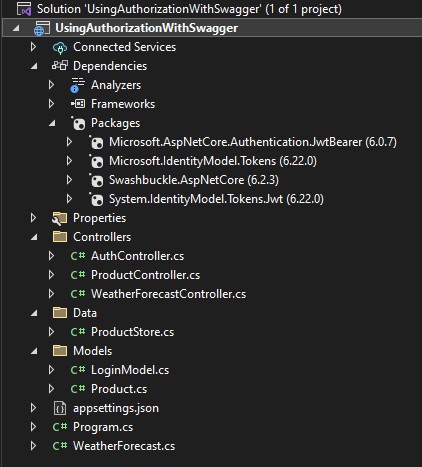
Using Authorization with Swagger in ASP.NET Core

 Create Solution like below LoginModel.cs using System.ComponentModel.DataAnnotations; namespace UsingAuthorizationWithSwagger.Models {     ...