Firstly Add References:=Microsoft Excel 11.0 Object Library
Dim objExcel As New Excel.Application
Dim oWB As Excel.Workbook
Dim oWS As Excel.Worksheet
Function convertexcel()
Dim line As String
Dim Count As String
h = 2
Dim TextLine As String
Open filename For Input Shared As #1
Do While Not EOF(1) '// Loop until end of file.
Line Input #1, TextLine '// Read line into variable.
' use the TextLine herer...
line = TextLine
Loop
Close #1
'create excel file
Set oWB = objExcel.Workbooks.Add
Set oWS = oWB.Worksheets("Sheet1")
bname = oWB.Name
oWS.Cells.Columns.AutoFit
oWS.Cells.WrapText = False
oWS.Range("A1").Value = "Date"
oWS.Range("B1").Value = "Time"
oWS.Range("C1").Value = "Voltage(ERRU1)"
oWS.Range("D1").Value = "Current(ERRU1)"
oWS.Range("E1").Value = "Voltage(ERRU2)"
oWS.Range("F1").Value = "Current(ERRU2)"
oWS.Range("G1").Value = "Charging Current"
oWS.Range("H1").Value = "Discharging Current"
oWS.Range("I1").Value = "Alternator RPM"
dtlog = Split(line, "FE FF")
For k = 0 To UBound(dtlog) - 1
log = dtlog(k)
If k = 0 Then
Dim dlog() As String
dlog = Split(log, "FF")
log = dlog(1)
End If
datalg = Split(log, " ")
Count = UBound(datalg)
If Count <= 21 Then
If Count >= 18 Then
time = datalg(3) & ":" & datalg(2)
date1 = datalg(4) & "/" & datalg(5) & "/" & datalg(6)
If exdate = "" Then
exdate = date1
Else
exdate = exdate & "," & date1
End If
If extime = "" Then
extime = time
Else
extime = extime & "," & time
End If
If dtr = "" Then
dtr = date1
Else
dtr = dtr + "," + date1
End If
oWS.Range("A" & h).Value = " " & Trim$(Trim$(datalg(4)) & "/" & Trim$(datalg(5)) & "/" & Trim$(datalg(6)))
oWS.Range("B" & h).Value = datalg(3) & ":" & datalg(2)
volt1 = HextoDec(datalg(7) & datalg(8))
vlt1value = Round((volt1 - 511) * 0.495, 2)
If vlt1value < 0 Then
vlt1value = 0
End If
cur1 = HextoDec(datalg(11) & datalg(12))
cr1value = Round((cur1 - 511) * 2.44, 2)
If cr1value < 0 Then
cr1value = 0
End If
volt2 = HextoDec(datalg(9) & datalg(10))
vlt2value = Round((volt2 - 511) * 0.495, 2)
If vlt2value < 0 Then
vlt2value = 0
End If
cur2 = HextoDec(datalg(13) & datalg(14))
cr2value = Round((cur2 - 511) * 2.44, 2)
If cr2value < 0 Then
cr2value = 0
End If
bcur = HextoDec(datalg(15) & datalg(16))
bcrvalue = Round((bcur - 511) * 2.44, 2)
freq1 = HextoDec(datalg(17) & datalg(18))
fr1value = Round((freq1 * 0.79) * 7.5)
If bcrvalue < 0 Then
bcrvalue = 0
End If
If fr1value < 0 Then
fr1value = 0
End If
oWS.Range("C" & h).Value = vlt1value
oWS.Range("D" & h).Value = cr1value
oWS.Range("E" & h).Value = vlt1value
oWS.Range("F" & h).Value = cr2value
oWS.Range("G" & h).Value = bcrvalue
oWS.Range("I" & h).Value = fr1value
h = h + 1
End If
End If
Count = ""
Next k
If Val(Application.Version) < 12 Then
'You use Excel 97-2003
FileExtStr = ".xls": FileFormatNum = -4143
Else
'You use Excel 2007
FileExtStr = ".xls": FileFormatNum = 56
End If
TempFilePath = App.Path
TempFileName = "\Temp\All" & Hour(Now) & "-" & Minute(Now) & "-" & Second(Now)
oWB.SaveAs TempFilePath & TempFileName & FileExtStr, FileFormat:=FileFormatNum
oWB.close SaveChanges:=True
sfile2 = TempFilePath & TempFileName & FileExtStr
objExcel.Application.Quit
End Function
Friday, July 17, 2009


VB 6.0 code for checking file existing in a folder
Firstly add Reference Microsoft Scripting Runtime
Dim fso As New FileSystemObject
If fso.FileExists(App.Path & "\Excel Files\Default.xls") = False Then
Else
EndIf
Dim fso As New FileSystemObject
If fso.FileExists(App.Path & "\Excel Files\Default.xls") = False Then
Else
EndIf
VB 6.0 code for read data from a file
Dim line As String
Open filename For Input Shared As #1
Do While Not EOF(1) '// Loop until end of file.
Line Input #1, TextLine '// Read line into variable.
' use the TextLine herer...
line = TextLine
Loop
Close #1
Open filename For Input Shared As #1
Do While Not EOF(1) '// Loop until end of file.
Line Input #1, TextLine '// Read line into variable.
' use the TextLine herer...
line = TextLine
Loop
Close #1
VB 6.0 code for Open file using Microsoft Common Dialog Control 6.0
CommonDialog1.DialogTitle = "Open File"
CommonDialog1.Filter = "Log Documents (*.log)|*.log|Text Documents (*.txt)|*.txt|Excel Spreadsheets (*.xls)|*.xls"
CommonDialog1.FilterIndex = 1
CommonDialog1.Flags = cdlOFNFileMustExist + cdlOFNHideReadOnly
CommonDialog1.ShowOpen
Dim filename As string
filename = CommonDialog1.filename
Dim fl As String
fl = CommonDialog1.FileTitle
CommonDialog1.Filter = "Log Documents (*.log)|*.log|Text Documents (*.txt)|*.txt|Excel Spreadsheets (*.xls)|*.xls"
CommonDialog1.FilterIndex = 1
CommonDialog1.Flags = cdlOFNFileMustExist + cdlOFNHideReadOnly
CommonDialog1.ShowOpen
Dim filename As string
filename = CommonDialog1.filename
Dim fl As String
fl = CommonDialog1.FileTitle
VB 6.0 code for delete all files in a folder
On Error Resume Next
MkDir App.Path & "\Temp"
DeleteAllFiles App.Path & "\Temp"
Public Function DeleteAllFiles(ByVal FolderSpec As String) As Boolean
Dim oFs As New FileSystemObject
Dim oFolder As Folder
Dim oFile As file
If oFs.FolderExists(FolderSpec) Then
Set oFolder = oFs.GetFolder(FolderSpec)
On Error Resume Next
For Each oFile In oFolder.Files
oFile.Delete True 'setting force to true
'deletes read-only file
Next
DeleteAllFiles = oFolder.Files.Count = 0
End If
End Function
MkDir App.Path & "\Temp"
DeleteAllFiles App.Path & "\Temp"
Public Function DeleteAllFiles(ByVal FolderSpec As String) As Boolean
Dim oFs As New FileSystemObject
Dim oFolder As Folder
Dim oFile As file
If oFs.FolderExists(FolderSpec) Then
Set oFolder = oFs.GetFolder(FolderSpec)
On Error Resume Next
For Each oFile In oFolder.Files
oFile.Delete True 'setting force to true
'deletes read-only file
Next
DeleteAllFiles = oFolder.Files.Count = 0
End If
End Function
Check Tablename in Database using VB 6.0
Dim con As New ADODB.Connection
Dim rs As New ADODB.Recordset
Dim tables() as String
Dim tablename as String
Dim msg as String
Dim table1 as String
If con.State = adStateOpen Then
con.Close
End If
con.Open
Set rs = con.OpenSchema(adSchemaTables, Array(Empty, Empty, Empty, "TABLE"))
Do Until rs.EOF
If table1 = "" Then
table1 = rs!table_name
Else
table1 = table1 & "," & rs!table_name
End If
rs.MoveNext
Loop
rs.Close
Set rs = Nothing
msg = IsInArray(tablename, tables())
Public Function IsInArray(FindValue As Variant, arrSearch As Variant) As Boolean
On Error GoTo LocalError
If Not IsArray(arrSearch) Then Exit Function
If Not IsNumeric(FindValue) Then FindValue = LCase(FindValue)
IsInArray = InStr(1, vbNullChar & Join(arrSearch, vbNullChar) & vbNullChar, _
vbNullChar & FindValue & vbNullChar) > 0
Exit Function
LocalError:
'Justin (just in case)
End Function
Dim rs As New ADODB.Recordset
Dim tables() as String
Dim tablename as String
Dim msg as String
Dim table1 as String
If con.State = adStateOpen Then
con.Close
End If
con.Open
Set rs = con.OpenSchema(adSchemaTables, Array(Empty, Empty, Empty, "TABLE"))
Do Until rs.EOF
If table1 = "" Then
table1 = rs!table_name
Else
table1 = table1 & "," & rs!table_name
End If
rs.MoveNext
Loop
rs.Close
Set rs = Nothing
msg = IsInArray(tablename, tables())
Public Function IsInArray(FindValue As Variant, arrSearch As Variant) As Boolean
On Error GoTo LocalError
If Not IsArray(arrSearch) Then Exit Function
If Not IsNumeric(FindValue) Then FindValue = LCase(FindValue)
IsInArray = InStr(1, vbNullChar & Join(arrSearch, vbNullChar) & vbNullChar, _
vbNullChar & FindValue & vbNullChar) > 0
Exit Function
LocalError:
'Justin (just in case)
End Function
Subscribe to:
Posts (Atom)
Using Authorization with Swagger in ASP.NET Core
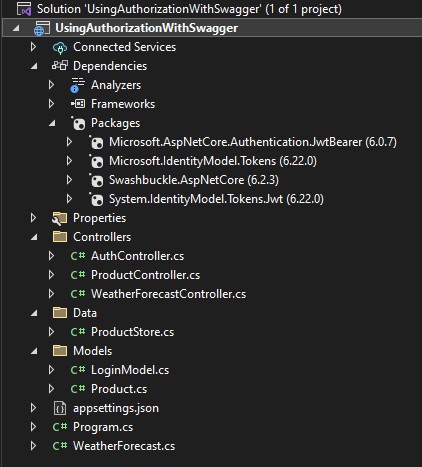
Create Solution like below LoginModel.cs using System.ComponentModel.DataAnnotations; namespace UsingAuthorizationWithSwagger.Models { ...
-
 using System; using System.Collections.Generic; using System.ComponentModel; using System.Data; using System.D...
 -
string[] Files; var root = Application.ExecutablePath; ...
-
 Inbox.aspx <%@ Page Title="" Language="C#" MasterPageFile="~/Marketing/admin.master" EnableEventValid...